




Work Details
| Scoring: | 2[1/pic.2]221-2200-tmp,tim,pla,bom,caj-str-SA |
| Text Author: | María Jesús Santervas |
| Language: | Spanish |
| Genre: | Children |
| Collection: | CM Orchestra |
| Instrument. Parts: | For rent |
| Reference: | CM.4.0005 |
| ISMN: | 979-0-69203-054-6 |
| Composition: | 1992 |
| Publication: | 2011 |
| Duration: | 15m19s |
| Pages: | 52 |
Multimedia
| First Page |
| Perusal Copy (free) |
Description
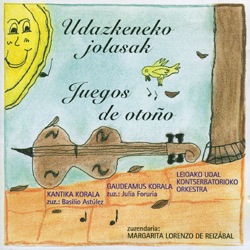
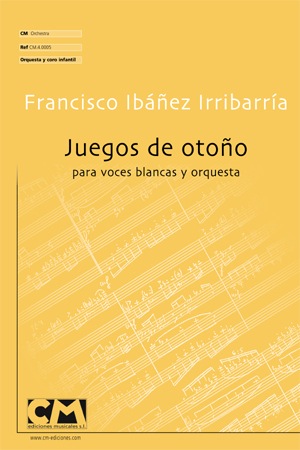
Juegos de Otoño (Autumn Games) is the new work by maestro Francisco Ibáñez Irribarría that CM Ediciones Musicales S.L. adds to its publishing catalog, following the release of other choral works—featuring instrumental or orchestral accompaniment—by the same composer, such as Hitzera Itzuli, Ave Maria in memoriam, and Dona nobis pacem. With this new addition, CM Ediciones makes available to performers and educators a quality body of children’s choral music, responding to a growing demand for this type of repertoire from musicians and teachers alike.
This publication of Autumn Games has been made possible thanks to the support of the Department of Culture of the Basque Government.
Autumn Games originated from a commission made to Francisco Ibáñez by the Federation of Children’s Choirs of Álava. The piece was composed in 1992 and premiered in May of the following year by a large choral ensemble of 550 children’s voices and the Ertzaintza Band, conducted by Juanjo Mena. Later, in 1996, Ibáñez Irribarría re-orchestrated the work, and this version for children’s choir and orchestra was recorded under Maestro Mena’s direction. The composer based the work on a strophic poem by María Jesús Santervás, his wife, and the piece is dedicated to their son Mikel, who at the time was only a few months old.
The structure of the composition follows the distribution of the poem into ten stanzas, but the composer avoids fragmentation by creating a continuous flow, with natural instrumental transitions linking the different stanzas. Additionally, he reuses the same musical material in both the first and last stanzas, giving the piece a clear sense of unity. It is as if the work were a reimagining of the traditional sonata form, with sections of exposition, development, and recapitulation. Reinforcing the sense of recap in the tenth stanza, the music—after a complex harmonic journey—returns to the original key of F major, a tonality curiously associated with pastoral and rustic expression (see Beethoven’s Pastoral Symphony) and, more specifically, with the evocation of autumn (as in Autumn from Vivaldi’s The Four Seasons). The composer, however, affirms that this association was not deliberate, which only deepens the mysterious link between specific expressive needs and specific tonalities.
José Luis García del Busto